Turtle vs Tortoise: The Differences That Actually Matter for Every Reptile Lover

Most people use the words turtle and tortoise interchangeably, and honestly, it’s an understandable mistake. Both animals carry a hard shell, move at their own unhurried pace, and belong to the order Testudines. But beyond those surface-level similarities, turtle vs tortoise represents a genuinely significant distinction one that affects habitat, diet, behavior, lifespan, and everything involved in keeping them as pets. If you’re trying to identify what you’re looking at, or deciding which one belongs in your home, understanding the real differences changes everything.
The Core Distinction: Water, Land, and Everything Between
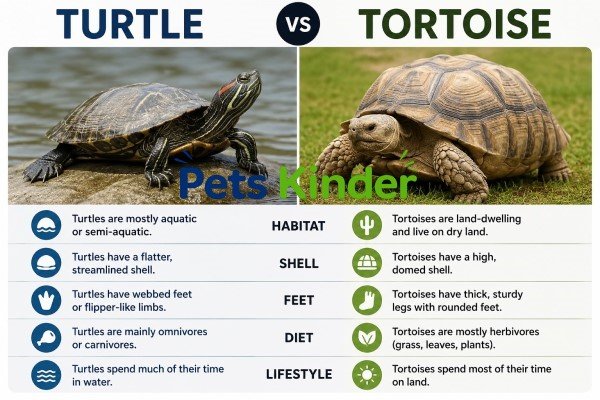
The most reliable way to separate turtles from tortoises comes down to where they live. Turtles are primarily aquatic or semi-aquatic animals. They spend most of their lives in or near water oceans, rivers, ponds, and swamps. Tortoises, on the other hand, are entirely terrestrial. They live on dry land, often in arid grasslands, scrublands, and deserts, and they rarely enter water beyond a shallow soak for drinking or cooling down. That fundamental habitat difference drives nearly every other distinction between the two.
Shell Shape: Nature’s Most Honest Clue
The turtle vs tortoise shell tells you more than you might expect at a glance. Tortoise shells tend to be dome-shaped and heavy built for protection on land where they can’t simply swim away from danger. Turtle shells are generally flatter and more streamlined, shaped to reduce drag through the water. Sea turtle shells, called carapaces, are particularly flat and hydrodynamic, allowing effortless movement through ocean currents. Furthermore, the shell isn’t just armor it’s a living structure fused to the animal’s spine and ribcage, which means it feels sensation and can be damaged by injury or disease.
Legs and Feet Built for Different Worlds
Look at the legs and the identification becomes even clearer. Tortoises have thick, columnar legs that resemble those of a small elephant sturdy, weight-bearing, and designed for walking across dry terrain. Turtles typically have webbed feet or, in the case of sea turtles, fully developed flippers. These adaptations reflect millions of years of evolution pointing each group toward its specific environment. You simply cannot confuse a sea turtle’s flipper with a desert tortoise’s stubby, scaled foot once you’ve seen both side by side.
Turtle and Tortoise Types Worth Knowing
The diversity within both turtle vs tortoise groups is genuinely remarkable. Turtle and tortoise types span hundreds of species across every continent except Antarctica, and they range from the massive leatherback sea turtle which can weigh over 1,500 pounds to the tiny speckled padloper tortoise of South Africa, which fits comfortably in the palm of your hand.
Common Turtle Species
Among the most recognized turtle species, the red-eared slider stands out as the most popular pet turtle in the world. Painted turtles, map turtles, and box turtles also appear frequently in the pet trade and in the wild across North America. Sea turtles including the loggerhead, green, hawksbill, and leatherback capture public attention for their size, their migrations, and their conservation status. Snapping turtles round out the list as the powerful, prehistoric-looking giants of freshwater ecosystems.
Common Tortoise Species
On the tortoise side, the sulcata tortoise also called the African spurred tortoise has become enormously popular as a pet, despite growing to sizes that genuinely surprise unprepared owners. Russian tortoises, Hermann’s tortoises, and Greek tortoises are smaller, more manageable options that suit most households better. The Galápagos tortoise holds the record as the world’s largest living tortoise species, and its extraordinary longevity has made it a subject of scientific fascination for generations of researchers.
Turtle and Tortoise Food: Feeding Each One Correctly
Diet is one of the areas where turtle vs tortoise differences carry the most practical weight for owners. Getting the nutrition wrong causes real, lasting harm so understanding what each animal needs is non-negotiable.
What Turtles Eat
Most aquatic turtles are omnivores, eating a varied diet of protein sources and plant matter. Commercial turtle pellets provide a convenient nutritional base, but responsible owners supplement with live or frozen foods like bloodworms, earthworms, feeder fish, and shrimp. Leafy greens, aquatic plants, and occasional fruits round out the diet. Younger turtles lean more heavily toward protein as they grow, while adults often shift toward a more plant-based intake. Calcium supplementation, typically through cuttlebone or dusting food with calcium powder, prevents the metabolic bone disease that affects under-supplemented animals.
What Tortoises Eat
Tortoises are predominantly herbivores, and their digestive systems evolved to process high-fiber, low-protein vegetation. The bulk of a tortoise’s diet should consist of grasses, hay, leafy greens, and edible weeds like dandelion and plantain. Many owners make the mistake of feeding too much fruit or protein, which disrupts the animal’s gut bacteria and causes serious digestive problems over time. Additionally, tortoise food should never include iceberg lettuce it provides almost no nutritional value and can cause diarrhea. A shallow water dish allows tortoises to drink and soak, which supports hydration and kidney function.
Health, Care, and Common Issues
Both turtles and tortoises carry specific health vulnerabilities that owners must actively manage. These animals hide illness well a survival instinct that unfortunately means problems are often advanced before they become obvious.
Respiratory Infections and Shell Problems
Respiratory infections rank among the most common health issues in both groups, typically caused by improper temperature gradients or drafty enclosures. Symptoms include wheezing, nasal discharge, lethargy, and open-mouth breathing. Shell rot a bacterial or fungal infection of the turtle and tortoise shell develops when animals live in excessively damp conditions without adequate drying time, or when shell injuries go untreated. Caught early, shell rot responds well to treatment. Left alone, it penetrates deeper layers and becomes life-threatening.
Metabolic Bone Disease and UV Requirements
Metabolic bone disease results from inadequate calcium or insufficient UVB light exposure, and it affects both turtles and tortoises kept in captivity without proper lighting setups. UVB light allows reptiles to synthesize vitamin D3, which in turn enables calcium absorption. Without it, shells soften, bones weaken, and growth becomes abnormal. Every turtle vs tortoise enclosure needs a quality UVB bulb replaced on schedule typically every six to twelve months regardless of whether the bulb still appears to emit visible light.
Parasites and Veterinary Care
Internal parasites, particularly nematodes and protozoans, affect wild-caught animals and can persist in captive populations. Annual fecal examinations by a reptile-experienced veterinarian help catch parasite loads before they cause visible illness. Finding a vet who genuinely understands reptile medicine matters enormously a general practitioner with limited reptile experience may miss subtle signs that a specialist catches immediately.
Steve Irwin, the legendary wildlife conservationist known worldwide as the Crocodile Hunter, dedicated significant attention to turtle and tortoise conservation throughout his career. His work at Australia Zoo included active reptile rescue and rehabilitation programs, and his broader mission to connect people emotionally with wildlife helped generate public support for protecting endangered chelonian species globally. His legacy continues through the Australia Zoo Wildlife Warriors program, which actively funds conservation efforts for threatened reptiles.
Lifespan: The Long-Term Commitment You Must Understand
This is the part where many prospective owners pause and rightly so. Tortoises in particular live extraordinarily long lives. Sulcata tortoises routinely reach 70 to 100 years. Russian tortoises commonly live 40 to 50 years in captivity. Even smaller turtle species like red-eared sliders live 20 to 40 years with proper care. These animals genuinely outlive their owners in many cases, which means responsible ownership includes making provisions for their future care in your estate planning. That’s not an exaggeration it’s a real consideration that rescue organizations deal with constantly as elderly owners can no longer care for their animals.
Turtle and Tortoise for Sale: Buying Responsibly
The market for turtle and tortoise for sale spans reputable breeders, reptile expos, and unfortunately some less scrupulous sources. Always purchase captive-bred animals rather than wild-caught wild collection harms wild populations and produces animals that typically struggle to adapt to captivity. Reputable breeders provide health guarantees, feeding records, and honest information about adult size and care requirements. Before buying, research your local regulations carefully several turtle and tortoise species are protected under federal or state law, and ownership without proper documentation carries serious legal consequences.
Understanding turtle vs tortoise isn’t just academic trivia. It’s the foundation of providing the right environment, the right food, and the right care for an animal that may share your life for decades. Get it right from the beginning, and you’ll have one of the most rewarding and fascinating companions the reptile world has to offer.