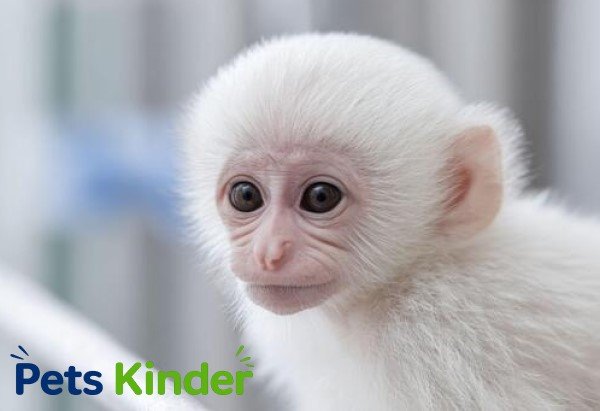
There’s something genuinely arresting about a white monkey. Whether it’s the ghostly coat of an albino macaque sitting motionless in a forest canopy, the silver-white fur of a white-faced capuchin catching afternoon light, or the striking pale coloring of a rare leucistic langur, these animals stop people in their tracks. White monkeys aren’t a single species they’re a phenomenon that appears across multiple primate families, each with its own story, biology, and place in the natural world. Understanding them means understanding both the science behind their coloring and the extraordinary animals beneath it.
What Exactly Is a White Monkey?
The term white monkey covers several distinct biological realities. In some cases, white coloring in primates results from albinism a genetic condition that eliminates melanin production entirely, resulting in white or pale fur, pink skin, and red or pink eyes. In other cases, it stems from leucism, a separate condition that reduces pigmentation without affecting the eyes, leaving the animal with white or pale fur but normally colored eyes.
Beyond these genetic conditions, several primate species naturally carry white or predominantly pale coloring as their standard appearance. The white-faced capuchin, the white-handed gibbon, the silvery marmoset, and certain langur species all display striking pale or white features as part of their normal genetics. So when someone refers to a white monkey, they could mean any one of a surprisingly wide range of animals each fascinating in its own right.
Species That Naturally Display White Coloring
The White-Faced Capuchin
Perhaps the most recognizable naturally white-marked primate in the world, the white-faced capuchin is native to Central America and the northwestern regions of South America. These medium-sized monkeys sport a distinctive white face, chest, and shoulders set against a dark brown to black body a contrast that makes them immediately identifiable. They’re extraordinarily intelligent, ranking among the most cognitively sophisticated of all New World monkeys.
White-faced capuchins use tools, demonstrate problem-solving abilities that researchers have studied extensively, and maintain complex social hierarchies within their troops. Their intelligence, combined with their striking appearance, unfortunately made them popular in the exotic pet trade for decades a practice now widely condemned and increasingly illegal across their range countries.
Albino and Leucistic Monkeys Across Species
Albino individuals appear sporadically across many primate species, including rhesus macaques, spider monkeys, and baboons. These animals face significant challenges in the wild. Without normal pigmentation, albino monkeys are far more visible to predators, more susceptible to sun damage and UV-related eye problems, and often rejected or treated differently by their social groups. Survival rates for albino primates in wild populations are considerably lower than for normally pigmented individuals.
Leucistic monkeys fare somewhat better since their eyes function normally, giving them better vision in bright conditions than true albinos. However, they still face visibility disadvantages in environments where camouflage provides survival value. Both conditions occasionally attract intense attention from researchers and wildlife photographers, and documented sightings of white monkeys in the wild consistently generate significant scientific and public interest.
The Silvery Marmoset
Found in the eastern Amazon Basin of Brazil, the silvery marmoset represents one of the most naturally and consistently white-colored primates in existence. Their fur is predominantly silver-white with a pale yellowish-orange tinge on the tail, and their bare face displays a distinctly reddish skin tone. Small and agile, these marmosets live in family groups and communicate through an elaborate range of vocalizations and scent markings.
The silvery marmoset’s white coloring isn’t a genetic anomaly it’s simply how they look, the result of thousands of years of evolutionary development in their specific Amazonian habitat. Their pale coat may offer advantages in the dappled light conditions of their forest environment, though researchers continue to study the precise adaptive significance.
Key Physical Characteristics
White monkeys, regardless of species, tend to draw attention for reasons beyond just their coloring. Most primate species that display white or pale features combine that coloring with other striking physical traits unusually expressive faces, distinctive body proportions, or remarkable dexterity. The white-faced capuchin, for instance, has hands remarkably similar in function to human hands, capable of fine manipulation that surprises most people who observe them up close.
Size varies enormously across the species that fall under the white monkey umbrella. Silvery marmosets weigh as little as 12 ounces, while larger species like the white-handed gibbon can reach 13 to 15 pounds. Body structure, tail length, limb proportions, and facial features all reflect each species’ specific evolutionary path and ecological niche.
Diet and Nutrition in the Wild and Captivity
Most white monkey species are omnivores with strong frugivorous tendencies meaning fruit forms the foundation of their diet, supplemented by insects, small vertebrates, eggs, leaves, and occasionally other plant material depending on season and availability. White-faced capuchins are particularly well-documented foragers, using stones to crack open hard nuts and shells in behaviors that parallel early human tool use.
In captivity, nutrition is one of the most frequently mismanaged aspects of primate care. A diet that approximates natural variety fresh fruits, vegetables, protein sources, and appropriate supplementation for vitamins D3 and C, which primates cannot synthesize independently is essential for long-term health. Deficiencies in vitamin D3 and calcium lead to metabolic bone disease, one of the most common and preventable health problems seen in captive primates.
Health, Care, and Common Issues
Physical Health Challenges Specific to White-Colored Primates
For albino white monkeys specifically, ongoing health management revolves significantly around sun protection and eye care. Without melanin, UV radiation causes cumulative damage to skin and eyes that can become severe over time. Albino primates in captivity require shaded environments, monitoring for skin lesions, and regular ophthalmic evaluation. Their vision is often compromised regardless of protective measures, creating additional welfare considerations in any captive setting.
Disease Susceptibility and Veterinary Care
Primates as a group share significant biological similarities with humans, which means they’re susceptible to many of the same diseases including respiratory infections, herpes viruses, tuberculosis, and various parasitic conditions. This biological closeness cuts both ways: humans can transmit diseases to primates and vice versa, making hygiene and veterinary oversight non-negotiable components of responsible care in any captive setting.
Lifespan and Long-Term Considerations
Lifespan varies by species. Capuchins in captivity routinely live 40 to 45 years a commitment most people dramatically underestimate. Marmosets typically live 10 to 15 years. Gibbons can reach 25 to 30 years in well-managed environments. The long lifespan of many primate species means that acquiring one as a pet even where legal represents a decades-long responsibility that outlasts many human relationships, careers, and living situations.
A Famous Perspective on Primates and Conservation
Primatologist and conservationist Jane Goodall has spent over six decades arguing that our closest animal relatives deserve both scientific respect and genuine moral consideration. Her work, which began with chimpanzees in Tanzania and expanded into a global conservation mission, fundamentally changed how humanity understands primate intelligence, emotion, and social complexity. Goodall’s perspective applies directly to white monkeys and all their kin these are not curiosities or status symbols, but sentient, socially complex animals whose welfare demands serious commitment.
Why the White Monkey Continues to Captivate
The white monkey endures as one of nature’s most compelling images precisely because it sits at an intersection of rarity, beauty, and biological intrigue. Whether produced by albinism, leucism, or simply the natural palette of a remarkable species, white coloring in primates commands attention and invites deeper questions. These animals are far more than their striking appearance they’re windows into primate evolution, conservation challenges, and the extraordinary diversity of life that still exists, often barely noticed, in forests most of us will never visit.