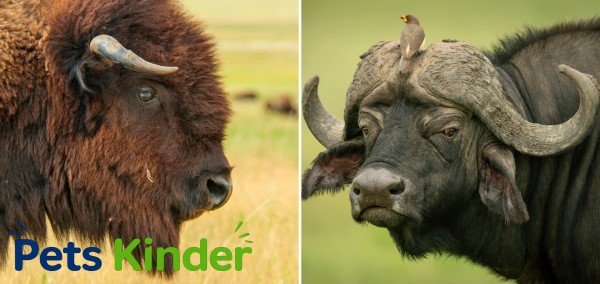
If you’ve ever called a bison a buffalo, you’re in very good company. Most people use these two names interchangeably, and honestly, it’s an easy mistake to make. Both animals are massive, both are horned, and both have played enormous roles in human history. However, bison and buffalo are actually two entirely different animals separated by thousands of miles, distinct evolutionary paths, and a surprising number of biological differences. The bison vs buffalo debate isn’t just a fun trivia fact. It tells a deeper story about how animals adapt, how cultures name things, and why accuracy in science matters more than convenience.
How Did the Confusion Between Bison and Buffalo Even Start?
The mix-up goes all the way back to early European explorers arriving in North America. When they encountered the massive, shaggy creatures roaming the Great Plains, they loosely applied the term “buffalo” a word they already associated with large bovines from Africa and Asia. The name stuck, passed down through generations, songs, and even state nicknames. Today, the American bison carries both labels, even though it isn’t a true buffalo at all. Understanding bison vs buffalo starts with tracing exactly where this centuries-old naming error began.
True Buffalo: What They Actually Are
True buffalo species live in Africa and Asia, and they differ significantly from their North American look-alikes. The African buffalo, also known as the Cape buffalo, roams sub-Saharan Africa in large herds. It’s known for its wide, curved horns that sweep downward before curling up a shape completely unlike what you see on a bison. The water buffalo, native to South and Southeast Asia, is a large domesticated bovine used for farming, transportation, and milk production across many cultures. Both of these animals belong to the genus Syncerus or Bubalus, not Bison.
What Makes a Bison a Bison?
Bison belong to the genus Bison, and two species exist today the American bison (Bison bison) and the European bison, also called the wisent (Bison bonasus). The American bison is the one most people picture: a towering, thick-shouldered animal with a massive hump, a shaggy dark mane, and a broad, heavy head that hangs low. The wisent, by contrast, is slightly leaner, taller in the legs, and lives primarily in the forests of Eastern Europe, particularly in Poland’s Białowieża Forest. Both species have survived near extinction, making their continued existence a remarkable conservation story.
Bison vs Buffalo: Breaking Down the Key Differences
When you place these animals side by side, the bison vs buffalo contrast becomes far easier to spot. The most obvious distinction is the shoulder hump. Bison have a pronounced muscular hump that sits high above their front legs, giving them that iconic, front-heavy silhouette. Buffalo have no such hump their backs slope more evenly from head to tail. This single physical feature alone is enough to tell the two animals apart at a glance, even from a considerable distance.
Horns, Coats, and Physical Build
Bison grow a thick, woolly coat that thickens dramatically in winter, helping them survive brutal Great Plains winters where temperatures plunge well below freezing. This heavy fur sheds each spring in dramatic clumps, giving bison a somewhat ragged look during the transition. Buffalo, especially the African Cape buffalo, have much shorter, coarser coats because they live in warmer, tropical climates where dense fur would be a liability rather than an advantage. This coat difference alone highlights just how differently bison vs buffalo have evolved to suit their environments.
Horn shape also tells a clear story. Bison horns are relatively short, curving upward and outward symmetrically. The Cape buffalo’s horns, on the other hand, form a heavy, fused “boss” across the forehead before curling outward and upward dramatically a structure powerful enough to send lions airborne. Water buffalo horns sweep back and outward in wide, gentle arcs that can span over five feet from tip to tip.
Size and Strength
American bison are among the largest land animals in North America. Mature bulls can weigh anywhere from 1,000 to 2,200 pounds and stand nearly six feet tall at the hump. Despite their size, bison are surprisingly agile, capable of running up to 40 miles per hour and pivoting quickly on their feet. Cape buffalo are formidable in their own right, reaching weights of up to 1,750 pounds, and water buffalo can exceed 2,600 pounds in some cases making them actually heavier than most bison. Still, the bison’s bulk combined with its speed makes it one of the most physically impressive animals on earth.
Diet, Nutrition, and Daily Habits
Both animals in the bison vs buffalo comparison are herbivores, grazing on grasses, sedges, and other plant matter throughout the day. Bison are highly adapted grazers perfectly suited to open grasslands. They use their massive heads like snowplows in winter, sweeping aside snow to reach the dried grasses underneath a behavior that shows just how well-evolved they are for cold climates.
Buffalo tend to prefer areas near water sources, especially the water buffalo, which regularly wades into rivers and marshes to cool off and escape insects. The Cape buffalo grazes primarily on coarse grasses that other animals avoid, making it an important part of its ecosystem’s food web. All of these animals require enormous quantities of food daily often consuming 30 or more pounds of plant material to sustain their massive frames.
Health, Lifespan, and Common Challenges
Bison in the wild typically live 15 to 20 years, with some individuals reaching 25 years in managed or protected environments. Cape buffalo have a similar lifespan, generally living 15 to 25 years in the wild. Water buffalo, particularly domesticated populations, can live 25 years or more under proper care.
Diseases and Conservation Concerns
Bison face ongoing challenges related to brucellosis, a bacterial disease that causes reproductive issues and has created tension between bison conservation efforts and neighboring cattle ranchers. Yellowstone National Park bison herds carry the disease, sparking decades of debate about wildlife management and livestock protection. Cape buffalo are also susceptible to foot-and-mouth disease and corridor disease, both of which can devastate herds and spread to domestic cattle. Conservation programs across Africa, Europe, and North America have worked tirelessly to monitor herd health, expand genetic diversity, and reduce human-wildlife conflict.
A Famous Voice for Bison Conservation
Former U.S. President Barack Obama has spoken about the importance of wildlife conservation during his time in office, and in 2016 he signed the National Bison Legacy Act into law, officially designating the American bison as the national mammal of the United States. This landmark moment brought long-overdue recognition to an animal that had nearly been wiped out reduced from an estimated 30 to 60 million individuals in the 1800s to fewer than 1,000 by the early 20th century. Today, thanks to dedicated conservation efforts, the population has rebounded to roughly 500,000 animals across North America.
Why the Bison vs Buffalo Distinction Matters More Than You Think
The bison vs buffalo debate might seem like a minor linguistic issue, but it carries real weight. Accurate naming helps scientists, conservationists, and policymakers communicate clearly about species-specific needs, threats, and protections. Calling a bison a buffalo however casually blurs the line between two distinct evolutionary stories happening on opposite sides of the world.
Both animals deserve recognition on their own terms. The bison shaped entire civilizations across the Great Plains and now stands as a symbol of American resilience and renewal. The buffalo whether the African Cape buffalo or the Asian water buffalo has sustained human communities for thousands of years through agriculture, sustenance, and cultural significance. Learning the real difference between bison and buffalo doesn’t diminish either animal. If anything, it deepens your appreciation for just how remarkable both of them truly are.