The Eurasian Eagle Owl: The World’s Largest Owl That Rules the Night With Ruthless Precision

There’s something almost mythological about the Eurasian eagle owl. It’s enormous. It’s silent. It hunts in complete darkness and can take down prey several times its own body weight. Across Europe and Asia, people have told stories about this bird for centuries and honestly, the real animal is more impressive than any legend. Whether you’ve seen one in a wildlife center and felt your pulse quicken, or you’re just beginning to learn about raptors, the Eurasian eagle owl is the kind of species that demands your full attention.
What Is the Eurasian Eagle Owl?
The Eurasian eagle owl (Bubo bubo) is the largest owl species in the world by most measurements. It inhabits an enormous range stretching from Western Europe through Russia, Central Asia, China, and into the Middle East. Unlike many owl species that favor dense forest interiors, the Eurasian eagle owl is highly adaptable it occupies rocky cliffs, open moorlands, dense forests, semi-desert terrain, and even agricultural landscapes with suitable nest sites. That flexibility is a big reason why this bird has survived and thrived across such a vast and varied geography.
Key Physical Characteristics
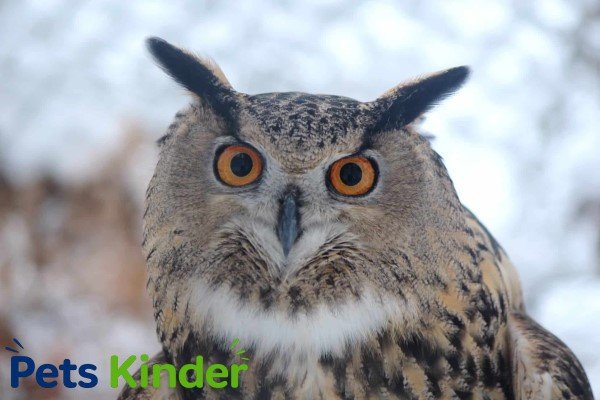
The Eurasian eagle owl is built like a predator at the very top of the food chain, and its physical features reflect that completely. Adults display a rich, tawny-brown plumage heavily streaked with dark brown and black, providing excellent camouflage against bark, rock, and dead vegetation. The facial disc is rounded and pale, framing two enormous orange eyes that seem almost too vivid to be natural. Those prominent feather tufts on the head often mistaken for ears are purely display structures with no role in hearing whatsoever.
The bill is powerful and strongly hooked, built for tearing through flesh and bone with ease. The talons are exceptionally large in some individuals, the grip strength rivals that of much larger raptors. The wings are broad and rounded, designed for slow, buoyant, nearly silent flight through varied terrain. Every physical detail of this bird points toward one purpose: efficient, devastating predation.
Eurasian Eagle Owl Size Comparison: Just How Big Is This Bird?
When people first encounter a live Eurasian eagle owl, their most common reaction is disbelief at the sheer size. So let’s put the Eurasian eagle owl size comparison into concrete terms.
Against Other Owls
The great horned owl, North America’s largest owl and a formidable predator in its own right, typically weighs between 2 and 5.5 pounds with a wingspan reaching around 44 inches. The Eurasian eagle owl, by contrast, weighs between 3.3 and 9.2 pounds with large females pushing toward the upper end and carries a wingspan that commonly reaches 63 inches and sometimes exceeds 75 inches in exceptional individuals. That’s over six feet of wingspan on a bird. No North American owl comes close to that scale.
Against Common Birds of Prey
Placed beside a red-tailed hawk, one of North America’s most recognized raptors, the size difference is startling. The red-tailed hawk tops out around 4 pounds. A large female Eurasian eagle owl more than doubles that. Even compared to a golden eagle itself a massive bird the Eurasian eagle owl holds its own in terms of bulk, though golden eagles typically win on wingspan and overall length. The Eurasian eagle owl size comparison with golden eagles is actually quite close, which tells you everything about how extraordinary this owl truly is.
The White Eurasian Eagle Owl: Fact or Myth?
The white Eurasian eagle owl is a topic that generates a lot of curiosity, and for understandable reasons. Photographs circulate online showing strikingly pale or nearly white eagle owls, and people naturally wonder whether a distinct white subspecies exists.
Understanding Color Variation
The truth is nuanced. There is no recognized subspecies of Eurasian eagle owl that is consistently white in the way a snowy owl is white. However, leucistic individuals do occur birds with a genetic reduction in pigmentation that produces a washed-out, pale, or near-white appearance. These white Eurasian eagle owl individuals are rare, but they’re documented. Leucism is different from albinism; leucistic birds often retain normal eye color (orange, in this species) while displaying dramatically lightened feather coloration. Captive breeding programs have also occasionally produced unusually pale individuals through selective breeding, which has contributed to the circulation of striking images online. So while a fully white wild Eurasian eagle owl is genuinely exceptional, it’s not impossible just very rare.
Diet and Hunting Behavior
The Eurasian eagle owl is an apex predator, and its diet reflects the full scope of that status. It eats almost anything it can overpower, which turns out to be quite a list. Rabbits, hares, rats, voles, and hedgehogs form the backbone of its diet across most of its range. But this bird also takes foxes, young roe deer, large waterfowl, herons, other raptors including buzzards and peregrine falcons and even other owls.
Hunting happens almost entirely at dusk and through the night. The Eurasian eagle owl uses its exceptional low-light vision in combination with highly sensitive directional hearing to locate prey in near-total darkness. It approaches silently on broad wings, drops on its target with precision, and kills quickly with those powerful talons. Unlike some raptors that primarily hunt from a perch, this owl also hunts on the wing, coursing low over open ground in search of movement.
Lifespan and Long-Term Considerations
In the wild, a Eurasian eagle owl typically lives between 20 and 25 years, though reaching that upper range requires surviving the considerable challenges of wild life territory competition, prey availability, and human-related hazards. In captivity, with reliable food and veterinary care, individuals have lived past 60 years. That’s an extraordinary lifespan for a bird, and it carries real implications for anyone considering keeping one in a falconry or educational context.
Long-term ownership or working relationships with this species demand serious commitment. These are not animals that tolerate neglect, inconsistency, or inadequate space. They bond with familiar handlers over time, but they never truly domesticate. Their predatory instincts remain fully intact regardless of how long they’ve been in human care.
Health, Care, and Common Issues
Housing and Enrichment Needs
A captive Eurasian eagle owl requires a large, well-constructed aviary with weatherproof shelter, elevated perches at varying heights, and protection from public disturbance. These birds are sensitive to chronic stress, and a poorly designed enclosure leads directly to behavioral problems and compromised immunity. Mental stimulation matters too birds housed in sterile, unchanging environments often develop repetitive behaviors that signal psychological distress.
Common Health Issues
Aspergillosis, a fungal respiratory disease, is one of the most serious health threats facing captive raptors including the Eurasian eagle owl. It develops when birds are housed in damp, poorly ventilated conditions and inhale spores from moldy substrate or food. Symptoms often don’t appear until the infection is advanced, making routine veterinary screening essential.
Bumblefoot a bacterial infection of the foot pads is another common captive raptor condition, typically caused by inappropriate perch surfaces or prolonged inactivity on hard substrate. Proper perch materials, regular foot inspections, and maintaining healthy body weight all reduce this risk significantly.
Parasites and Nutritional Deficiencies
Internal parasites, including roundworms and tapeworms, require regular fecal screening and appropriate deworming protocols. Nutritional deficiencies particularly thiamine deficiency from feeding exclusively on frozen prey that hasn’t been properly stored can cause neurological symptoms in severe cases. Feeding whole prey items that include fur, feathers, and bone is critical to the Eurasian eagle owl’s digestive health and provides the roughage it needs to produce healthy pellets.
Veterinary Care Requirements
Routine veterinary checkups by a qualified avian or raptor veterinarian are non-negotiable for captive birds. Annual health assessments, parasite screening, and weight monitoring catch problems early before they become life-threatening. In many countries, keeping a Eurasian eagle owl requires specific permits, and those regulations exist for good reason. This is a powerful, complex, long-lived animal that demands expert-level care throughout its entire life.
Why the Eurasian Eagle Owl Stands Apart
After everything the size, the predatory power, the striking coloration, the extraordinary lifespan what truly separates the Eurasian eagle owl from other birds is the combination of all those qualities in a single animal. Most large predators sacrifice one thing for another: speed for power, stealth for size, range for specialization. The Eurasian eagle owl seems to have avoided most of those trade-offs entirely.
It is simultaneously the largest owl alive, one of the most silent hunters in the sky, a survivor across wildly different ecosystems, and a bird that can outlive the person who first saw it in a field guide. That’s not just impressive biology that’s a legacy built over millions of years of evolutionary refinement. Respecting this bird means understanding it fully, in all its complexity and all its demands. And that understanding, once it settles in, doesn’t easily leave you.